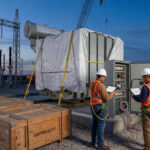

The National Electrical Code (NEC) has rolled out significant updates that fundamentally change how customer-owned medium-voltage systems (over 1,000 Volts AC / 1,500 Volts DC) must be designed and documented. These rules directly impact industrial substations, battery energy storage systems (BESS), and large-scale renewable generation sites.
Critical Changes You Need to Map Out
The updates focus heavily on structural safety, equipment access, and exact site tracking:
- The 12-Inch Rule for Cable Trays: The code now mandates a strict 12-inch minimum vertical clearance between the top of one cable tray and the bottom of the next stacked tray. The vague requirement for “sufficient space” is officially gone, forcing design engineers to plan trench and tray elevations with absolute precision.
- Expanded Medium-Voltage Articles: Multiple new and revised articles (including Articles 245 through 270) completely separate installation methods for medium-voltage systems from traditional lower-voltage commercial practices.
- Alternate Source Disconnect Mapping: If your site integrates multiple distributed energy sources (e.g., wind turbines plus a battery yard feeding a central substation), the code now strictly requires detailed permanent directories and physical plaques mapping out every single source disconnect location.
Failure to meet these compliance baselines can lead to rejected interconnection permits and months of costly site remediation. Having an experienced commissioning engineer audit your design drawings against these updated standards prior to equipment deployment is the single most effective way to guarantee a smooth field sign-off.